A Public Sector Guide to Digital Accessibility Before the 2027 Deadline
Executive Summary
Two federal deadline extensions issued in spring 2026 have given public sector organizations additional time to meet their digital accessibility obligations:
- The U.S. Department of Justice (DOJ) extended Americans with Disabilities Act (ADA) Title II web accessibility compliance deadlines for state and local governments.
- The Department of Health and Human Services (HHS) extended its Section 504 Final Rule compliance deadlines for recipients of federal financial assistance.
For municipal governments, public universities, health systems and nonprofits navigating complex digital ecosystems on constrained budgets, the additional runway provides extra time to meet accessibility compliance standards.
But organizations that treat the extensions as permission to pause are taking on risks that will be significantly harder to manage as the new deadlines approach.
This white paper is designed for administrators and program leaders who are ready to move from awareness to action. It explains what each rule requires, where compliance gaps most commonly appear and what a structured, realistic path to conformance looks like in practice.
Aspiritech, a nonprofit and Forbes Accessibility 200 tech company whose workforce is more than 90% autistic, has spent nearly two decades building accessibility programs with public sector organizations across every category covered by these rules.
Send a PDF Version of This White Paper to Your Inbox
Executive Summary
Two federal deadline extensions issued in spring 2026 have given public sector organizations additional time to meet their digital accessibility obligations:
- The U.S. Department of Justice (DOJ) extended Americans with Disabilities Act (ADA) Title II web accessibility compliance deadlines for state and local governments.
- The Department of Health and Human Services (HHS) extended its Section 504 Final Rule compliance deadlines for recipients of federal financial assistance.
For municipal governments, public universities, health systems and nonprofits navigating complex digital ecosystems on constrained budgets, the additional runway provides extra time to meet accessibility compliance standards.
But organizations that treat the extensions as permission to pause are taking on risks that will be significantly harder to manage as the new deadlines approach.
This white paper is designed for administrators and program leaders who are ready to move from awareness to action. It explains what each rule requires, where compliance gaps most commonly appear and what a structured, realistic path to conformance looks like in practice.
Aspiritech, a nonprofit and Forbes Accessibility 200 tech company whose workforce is more than 90% autistic, has spent nearly two decades building accessibility programs with public sector organizations across every category covered by these rules.
Send a PDF Version of This White Paper to Your Inbox
Table of Contents
Understanding the Two Rules and What They Cover
ADA Title II and Public Sector Web Accessibility
The DOJ’s 2024 final rule under Title II of the ADA established, for the first time, specific and enforceable technical standards for web and mobile accessibility across state and local government. That standard is WCAG 2.1 Level AA conformance.
The April 20, 2026 Interim Final Rule extended the compliance deadlines but did not alter the substantive requirements. State and local government entities serving populations of 50,000 or more now have until April 26, 2027. Smaller jurisdictions and special district governments have until April 26, 2028.
The scope of platforms impacted by the rule is broad: agency websites, online permitting and licensing portals, public transit apps, utility payment systems, library platforms, court filing systems, school district parent portals and every other digital service offered by a covered government entity. Third-party platforms used to deliver those services are covered as well, which means vendor contracts are now essentially a compliance document.
The DOJ has indicated it may pursue further rulemaking during the extension period. No Notice of Proposed Rulemaking has been issued as of July 2026. Until any new rule is finalized, WCAG 2.1 Level AA is the operative standard.
HHS Section 504 and Federally Funded Programs
The Department of Health and Human Services Section 504 Final Rule applies to organizations that receive federal financial assistance from HHS. This includes public hospitals, community health centers, publicly funded behavioral health programs, federally qualified health centers and many nonprofit service providers.
On May 7, 2026, HHS issued an Interim Final Rule extending its WCAG 2.1 Level AA compliance deadlines by one year. Recipients with 15 or more employees now have until May 11, 2027. Smaller recipients have until May 10, 2028.
The underlying 2024 Final Rule remains fully in effect. The extension moves the technical conformance deadline; it does not modify the broader non-discrimination obligations under Section 504, which have been in force since the rule’s July 8, 2024 effective date. Organizations can still face complaints, investigations and enforcement action today if their digital experiences present barriers to people with disabilities.
Under 45 C.F.R. § 84.84(a), covered entities are also responsible for the accessibility of digital services delivered through contractual, licensing or other third-party arrangements. Patient portals, online scheduling tools, telehealth platforms, bill pay systems and digital intake forms provided by outside vendors fall within scope. A contractual relationship with a vendor does not transfer Section 504 liability to that vendor. The covered entity remains responsible.
When Both Rules Apply
For many public sector organizations, ADA Title II and HHS Section 504 apply simultaneously. A public university may be covered by Title II as a state entity and by Section 504 as a recipient of federal research or student financial aid funding. A county health department operating public health programs may fall under both as well.
Understanding which obligations apply to your organization, and where they overlap, is a necessary first step before building a compliance program. The compliance timelines are similar but not identical, and the scope of each rule has distinct characteristics that affect how an organization should structure its approach.
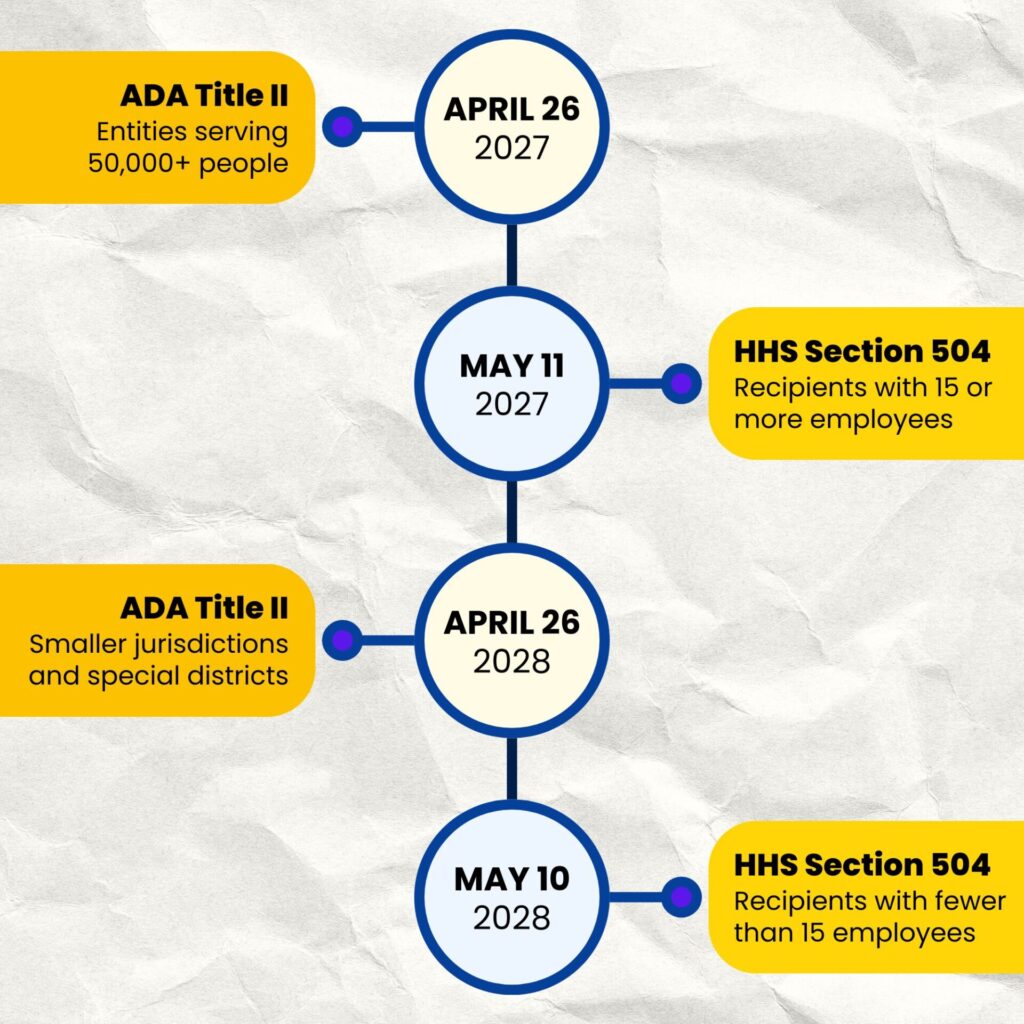
Key Deadlines at a Glance:
- April 26, 2027: ADA Title II for entities serving 50,000 people or more
- May 11, 2027: HHS Section 504 for recipients with 15 or more employees: May 11, 2027
- April 26, 2028: ADA Title II for smaller jurisdictions and special districts
- May 10, 2028: HHS Section 504 for recipients with fewer than 15 employees
Key Deadlines at a Glance:
- April 26, 2027: ADA Title II for entities serving 50,000 people or more
- May 11, 2027: HHS Section 504 for recipients with 15 or more employees: May 11, 2027
- April 26, 2028: ADA Title II for smaller jurisdictions and special districts
- May 10, 2028: HHS Section 504 for recipients with fewer than 15 employees
Where Public Sector Organizations Most Commonly Fall Short
The Limits of Automated Compliance Scanning
Many organizations begin their accessibility programs with automated scanning tools. These tools have real value as a first pass, but they surface only 30-40% of actual accessibility issues.
Automated scanners can flag missing alt text and some color contrast failures. They cannot evaluate whether a screen reader user can successfully complete a multi-step benefits application, whether keyboard navigation works consistently across a complex portal or whether dynamic content updates are announced correctly to assistive technology.
Public sector accessibility compliance requires human-led testing by people who use assistive technology in their daily lives. Without that foundation, it’s more likely that remediation efforts address visible surface issues while leaving significant barriers uncorrected.
High-Risk Content That Is Frequently Overlooked
The digital properties that carry the highest compliance risk are not always the most visible. Common gaps across the digital ecosystems of the public sector include:
- PDF documents published without tags, reading order or accessible form fields. Many government agencies and health systems publish hundreds of PDFs annually, few of which are reviewed for accessibility before publication.
- Legacy web content that predates current standards. For example, large municipal websites and university platforms often contain years of archived content that was never built to meet WCAG requirements.
- Third-party embedded tools. Online payment processors, scheduling systems, permit applications, patient portals and learning management systems are frequently provided by outside vendors whose accessibility conformance has never been formally evaluated.
- Video and multimedia content published without accurate captions or audio descriptions.
- Interactive features, including maps, data visualizations and dynamic forms, that have not been tested with assistive technology.
The Organizational Infrastructure Gap
Beyond technical remediation, covered entities are expected to have designated accessibility coordinators and documented grievance procedures for individuals who encounter barriers. They also need to have in place internal processes for maintaining conformance over time.
Many public sector organizations have not yet established these structures. That gap creates compliance vulnerability regardless of the accessibility of their platforms.
A Realistic Compliance Framework for Public Sector Organizations
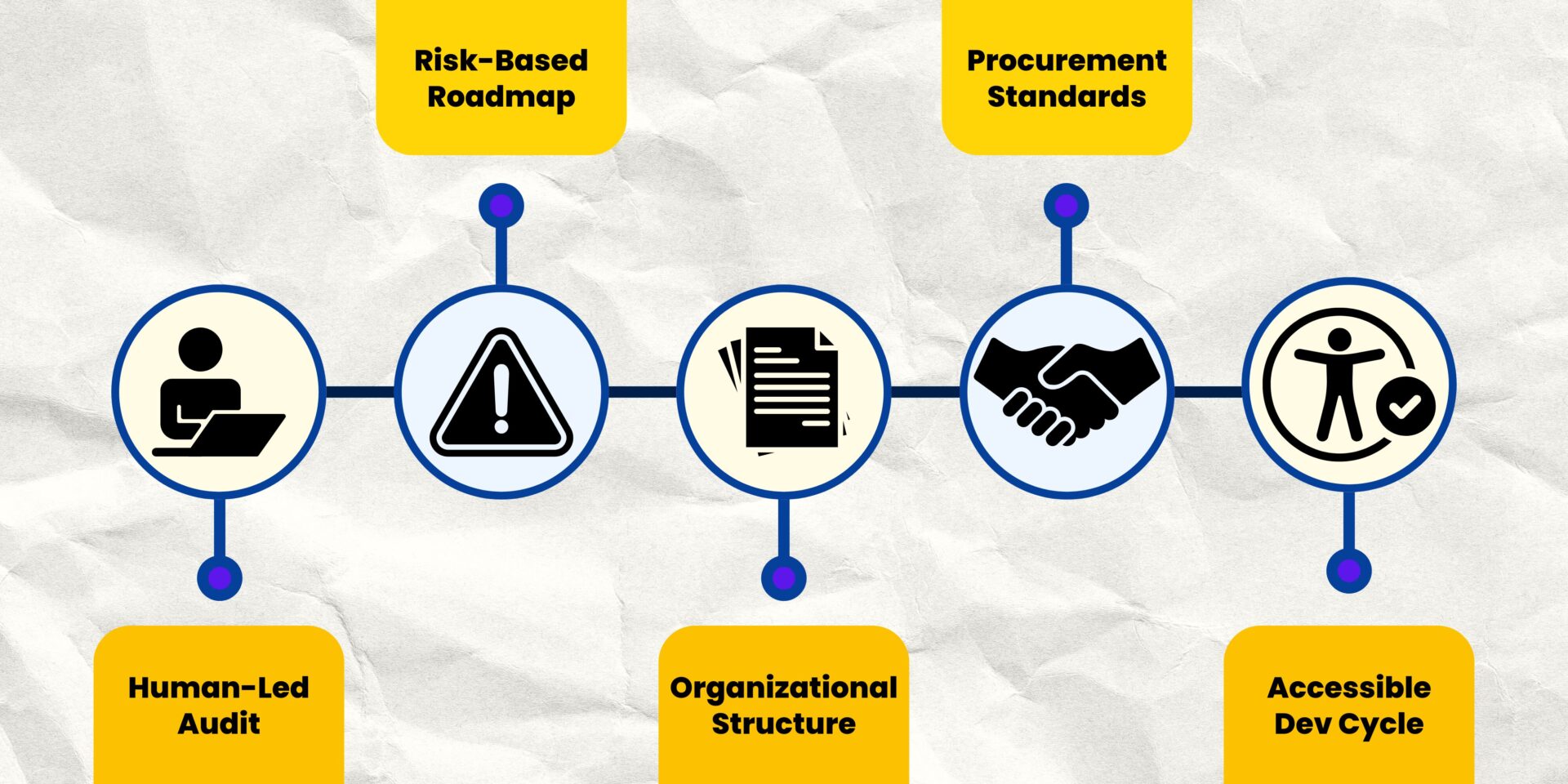
Start With a Scoped, Human-Led Audit
An accessibility audit that will actually support a compliance program is a structured evaluation of your highest-priority digital properties conducted by testers who use assistive technology and understand how real users navigate inaccessible environments.
The audit should produce a prioritized findings report that:
- Maps issues to WCAG 2.1 Level AA criteria
- Identifies the user impact of each barrier
- Provides actionable remediation guidance that your internal team or development partners can act on directly
That foundation is what makes everything downstream more efficient and more defensible. Its ROI in the face of legal action and brand trust cannot be overstated.
Build a Remediation Roadmap Organized by Risk
Most public sector organizations manage more digital properties than they can remediate simultaneously. A well-structured remediation plan sequences work by significance: The platforms that carry the highest compliance risk and the greatest impact on disabled users come first.
For municipal governments, that typically means public-facing service portals, benefits and permit applications, emergency communications and election information.
For health systems, it includes patient-facing scheduling, billing and communication platforms.
For universities, it means learning management systems, admissions portals and student services platforms.
For nonprofits receiving HHS funding, it includes program intake systems, resource directories and any platform through which clients access services.
The roadmap should be documented and time-sequenced against the applicable deadline. It should also be visible to organizational leadership. Ultimately, a credible compliance program needs a plan that can be produced and reviewed.
Establish the Required Organizational Structures
Although they might seem like bureaucratic formalities, designating an accessibility coordinator, building a grievance procedure and documenting internal review processes are key organizational infrastructure. They make a compliance program functional and defensible.
These structures also create the internal accountability that keeps accessibility programs active between audit cycles, rather than treating conformance as a one-time event.
Update Procurement Standards
Every technology contract your organization signs going forward is an accessibility decision. Vendor agreements should include explicit WCAG 2.1 Level AA conformance requirements, with documentation requested in writing. Accessibility conformance reports and voluntary product accessibility templates are the appropriate standard of evidence.
Verbal assurances from vendor sales teams are not enough. Vendor conformity is particularly important for health systems and nonprofits operating under Section 504. For these organizations, third-party platform liability rests with the covered entity regardless of vendor representations.
Integrate Accessibility Into the Development Cycle
The most cost-effective and durable path to compliance is building accessibility into how your organization creates and maintains digital content. Remediation should not come after the fact.
This requires training for content creators and development staff. Review processes that evaluate accessibility before new content or platforms are published must be put into place, as well.
Organizations that make this shift move from a reactive compliance posture to a proactive one. That shift also significantly reduces long-term remediation cost and produces more consistent results across a large, distributed digital ecosystem.
Why This Work Matters Beyond Compliance
Public sector digital accessibility is a civil rights obligation with decades of legal grounding. But the case for accessible government platforms, health systems and educational institutions extends well beyond regulatory compliance.
Human Impact of Inaccessible Platforms
More than one in four adults in the United States lives with a disability, according to the Centers for Disease Control. For many of them, inaccessible public sector platforms are barriers to healthcare, civic participation, educational opportunity and the public services their taxes and program eligibility entitle them to.
When a resident cannot complete a housing assistance application online, when a patient cannot schedule a health appointment independently, when a student cannot access course materials without assistance, the institution has failed a core function.
The Importance of Universal Design
People who do not currently live with a disability are not a separate population from those who do. Eventually, they will age into access needs or encounter disabilities from injury or illness. And they, like everyone else, will need to access public sector platforms.
Accessible digital infrastructure is not built solely for disabled users. Rather, it’s intentionally designed and maintained for everyone our public institutions serve, across every stage of life.
Universal design makes digital services better for all users. It reduces support burden by increasing self-service completion rates. It also builds the kind of public trust that government institutions, health systems, universities and nonprofits depend on to fulfill their missions.
How Aspiritech Supports Public Sector Compliance
Aspiritech is a nonprofit and Forbes Accessibility 200 tech company whose workforce is more than 90% autistic. For nearly two decades, we have built our partners accessibility programs that are rigorous, human-centered and built to last.
Our testing is conducted by autistic and neurodivergent professionals who navigate digital environments through the lens of disability every day. Their lived experience produces a depth of insight that automated tools simply cannot replicate and that drives the quality of every remediation guidance report and compliance program we deliver.
The 2027 deadlines are approaching. The organizations that will meet them with confidence are the ones building toward compliance now, not the ones waiting for the calendar to force the issue.
Aspiritech’s Accessibility Services for the Public Sector
- WCAG 2.1 AA audits
- Section 508 compliance testing
- HHS Section 504 readiness assessments
- ADA Title II compliance support
- Prioritized remediation guidance
- Vendor ecosystem evaluation
- Accessibility coordinator support
- Ongoing program partnership
How Aspiritech Supports Public Sector Compliance
Aspiritech is a nonprofit and Forbes Accessibility 200 tech company whose workforce is more than 90% autistic. For nearly two decades, we have built our partners accessibility programs that are rigorous, human-centered and built to last.
Our testing is conducted by autistic and neurodivergent professionals who navigate digital environments through the lens of disability every day. Their lived experience produces a depth of insight that automated tools simply cannot replicate and that drives the quality of every remediation guidance report and compliance program we deliver.
The 2027 deadlines are approaching. The organizations that will meet them with confidence are the ones building toward compliance now, not the ones waiting for the calendar to force the issue.
Aspiritech’s Accessibility Services for the Public Sector
- WCAG 2.1 AA audits
- Section 508 compliance testing
- HHS Section 504 readiness assessments
- ADA Title II compliance support
- Prioritized remediation guidance
- Vendor ecosystem evaluation
- Accessibility coordinator support
- Ongoing program partnership
Talk With Our Team
Aspiritech’s team is offering public sector entities free accessibility consultations. We will help you understand exactly where your organization stands and what a credible, sustainable path to conformance looks like for the people you serve.
Schedule a call with Business Development & Partnerships Manager Brenda Hauf or send her an email to get started.